 Rubika

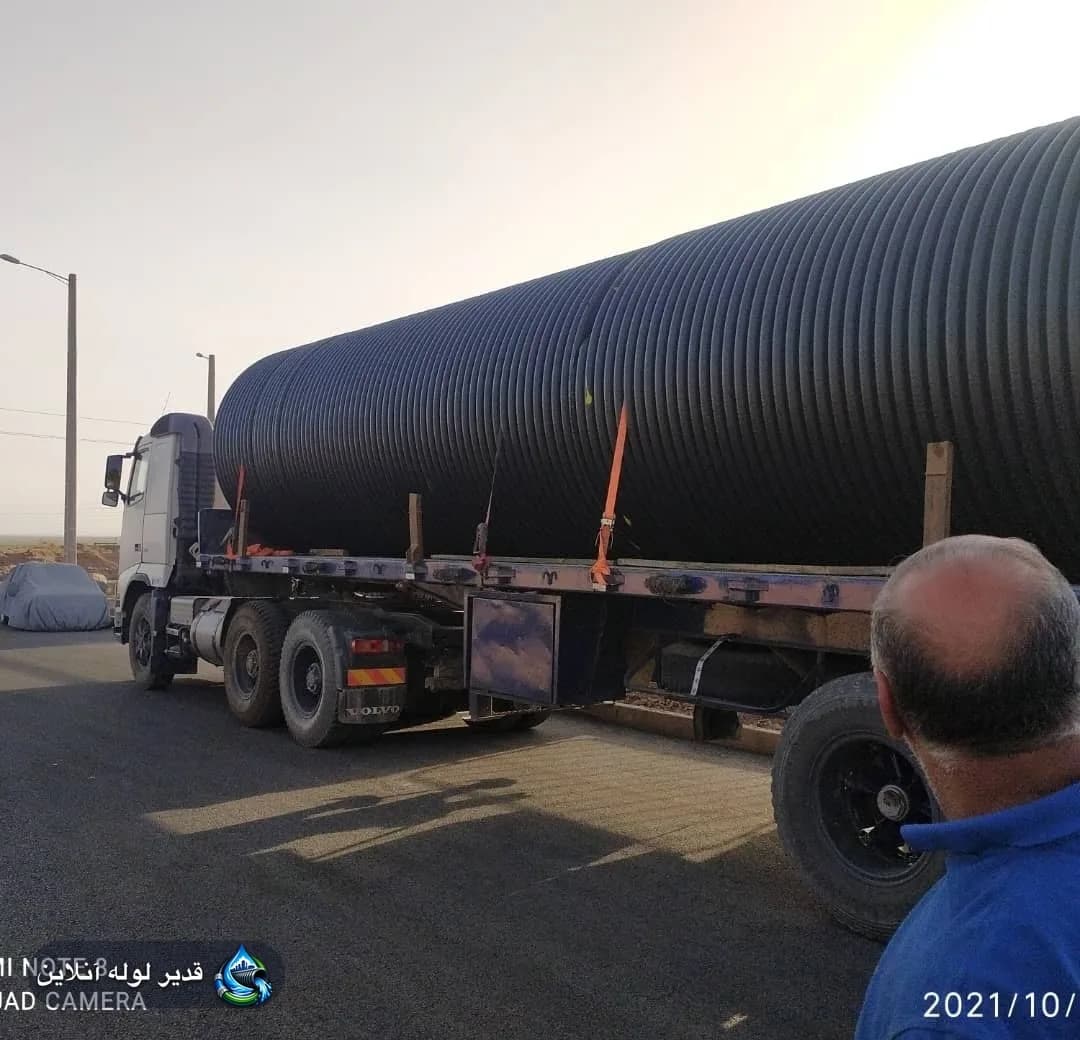
When the diameter required for a sewer or stormwater line exceeds about one meter, traditional options such as concrete and metal pipe are heavy, costly and vulnerable to corrosion. Polyethylene spiral pipe is made precisely for these large diameters. In this article we explain what spiral pipe is, how it differs from double-wall corrugated pipe and when to choose each one.
What is spiral pipe?
Spiral pipe is a polyethylene pipe with a spiral structured wall. In general, to produce it, a polyethylene profile is wound helically around a cylindrical mandrel and the edges of the profile are welded together as it is wound, creating a monolithic pipe with a smooth inner wall and a ribbed outer body. This spiral profile provides the ring stiffness needed to withstand soil loads without making the pipe as heavy as a solid-wall pipe.
Difference between spiral pipe and corrugated pipe
Both pipes are made from high-density polyethylene, have a structured wall and are used for gravity flow (sewage and surface water); the main differences are in diameter, production method and jointing method:
| Feature | Double-wall corrugated pipe | Spiral pipe |
|---|---|---|
| Diameters supplied (Qadir Lule) | 110 to 1200 mm | 900, 1400, 1600, 1800 and 2000 mm |
| Wall structure | Corrugated outer wall + smooth inner wall | Spiral profile + smooth inner wall |
| Production method | Continuous extrusion and forming of the corrugations in a mold | Helical winding of the profile with simultaneous welding of the edges |
| Jointing method | Coupler and EPDM rubber gasket | On-site extrusion welding |
| Ready-made fittings | Yes (elbow, tee, reducer, end cap…) | No separate fittings |
| Main application | Sewage and surface water collection networks, drainage | Main collectors, stormwater channels, culverts |
Put simply: up to a diameter of 1200 mm, double-wall corrugated pipe is usually the more economical and faster choice, because it has coupler joints and ready-made fittings are available. For larger diameters, spiral pipe replaces concrete and metal pipe. In this product line, size 900 mm is supplied only as spiral pipe.
Applications of spiral pipe
- Collectors and main sewer transmission lines: where the sewage from several branch networks is gathered and a large diameter is required.
- Urban stormwater and surface water channels: high volumes of runoff during heavy rainfall.
- Culverts: carrying water under roads, highways and railways.
- Industrial projects: effluent and surface water lines for large sites.
Advantages of spiral pipe over concrete and metal pipe
- Lower weight: transport by trailer and handling on site are done with lighter machinery.
- Corrosion resistance: polyethylene resists the corrosive gases and compounds in sewage that damage concrete pipe, and it does not rust.
- Smooth inner wall: smoother flow and less sedimentation.
- Monolithic welded joint: the joint seam is made monolithic by extrusion welding.
Spiral pipe stiffness class
Like corrugated pipe, spiral pipe is supplied in light-duty and heavy-duty classes, and the right class is selected based on the burial depth, soil type and traffic load along the route. In some technical data sheets, spiral pipe stiffness is given according to the DIN 16961 standard method, with values such as 16 and 31.5 kN/m², which are considered equivalent to the light-duty (SN4) and heavy-duty (SN8) classes respectively; do not compare these figures directly with the SN value obtained by the ISO 9969 method. The classes are fully explained in the article The difference between SN4 and SN8.
How to choose between spiral and corrugated pipe
- Take the required diameter from the hydraulic calculations: the design flow rate and route gradient determine the diameter, not the pipe type.
- If the diameter is up to 1200 mm: double-wall corrugated pipe is usually more economical and faster to install.
- If the diameter is greater than 1200 mm or exactly 900 mm: spiral pipe is the option in this product line.
- Choose the class based on the loading conditions and ask our specialists for the exact profile dimensions and pipe length before ordering.
Buying spiral pipe from the factory
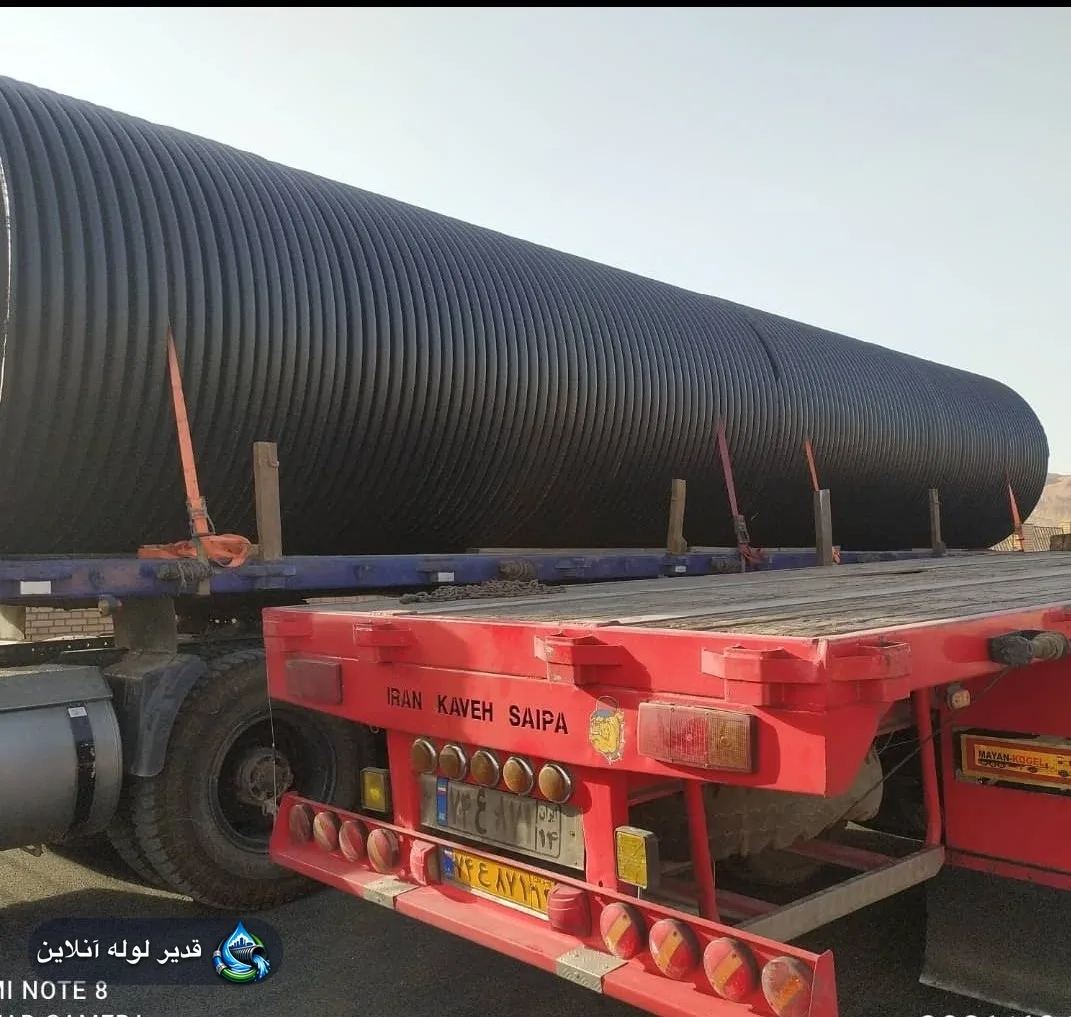
Ghadir Louleh Pasargad spiral pipe is produced in diameters from 900 to 2000 mm and delivered by trailer across Iran; for example, see the Spiral pipe 1400 page. See real photos of production and loading on the Factory page, and today's price in the price table. For collectors and large projects, submit the route specifications through the project inquiry form.