 Rubika

Two corrugated pipes of the same size may look exactly alike from the outside, yet one lasts fifty years underground while the other cracks or becomes oval a few years later. The difference is determined not by the pipe's appearance but by its raw materials and the tests it has passed. In this article we explain what the corrugated pipe standard in Iran is, what each of its tests guarantees, and how to tell a standard pipe from a poor-quality one when buying.
The national corrugated pipe standard: ISIRI 9116-3
Iranian National Standard ISIRI 9116-3 covers structured-wall plastic pipes made of polyethylene, polypropylene and PVC-U with a non-smooth outer surface (type B); in other words, the double-wall corrugated pipes used for non-pressure sewer and drainage networks. This standard is mandatory for this product: the manufacturer must obtain a licence to use the standard mark from the Iranian National Standards Organization and renew it at specified intervals.
Alongside this product standard, an ISO 9001 certificate shows that the factory has a documented quality management system; however, ISO 9001 is not a substitute for the product standard licence, and both should be checked.
Corrugated pipe quality tests and the importance of each
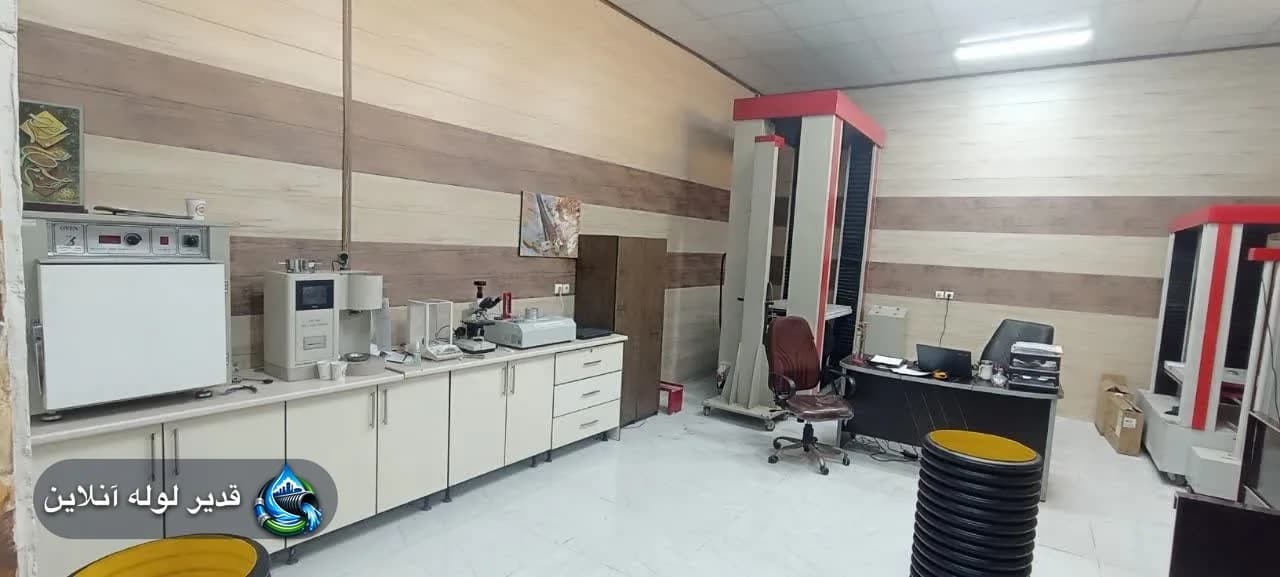
The factory's quality control laboratory carries out tests on samples from every production batch. The most important of them, and what each one guarantees:
| Test | What it measures | Why it matters |
|---|---|---|
| Dimensions | Inner and outer diameter, layer thicknesses, ovality | Proper fit with the coupler and gasket, and real hydraulic capacity |
| Ring stiffness (ISO 9969) | Resistance of the wall to deformation under load | Confirms the SN4 or SN8 class marked on the pipe |
| Carbon black content and dispersion | Amount and uniformity of carbon black distribution in the polyethylene | Protects the pipe against ultraviolet radiation during storage and installation |
| Melt flow index (MFI) | Behavior of the raw material when melted | Uniformity of the material grade; an abnormal change may indicate recycled or substandard material |
| Oxidation induction time (OIT) | Resistance of the material to oxidation | Adequacy of stabilizers and therefore a long pipe life |
| Density | Mass per unit volume of the material | Confirms that the raw material is high-density polyethylene suitable for pipe |
| Oven (heat) test | Behavior of the pipe after exposure to high temperature | Reveals residual stresses, layer separation and cracking caused by improper production |
| Impact | Resistance of the pipe to impact | Withstanding handling, loading and backfilling on site |
| Joint tightness | That the coupler and gasket joint does not leak | Prevents sewage leaking into the soil and groundwater and roots entering the network |
A sample test report for Ghadir Louleh Pasargad's 315 mm SN8 corrugated pipe, covering all of these tests, is published on the certificates and technical documents page.
What is marked on the body of a standard pipe?
The following information is usually printed or embossed on a standard corrugated pipe:
- Name or logo of the manufacturer
- Standard number and standard mark
- Nominal diameter of the pipe
- Ring stiffness class (SN4 or SN8)
- Material (e.g. PE)
- Production date or batch number for traceability
A pipe that carries none of this information cannot be traced, and if it causes a problem in the project, responsibility cannot be pursued.
Signs of poor-quality corrugated pipe
- A price far below the market: the price of corrugated pipe is effectively derived from the weight per metre and the raw material price; a pipe that is much cheaper is either produced lighter than the standard requires or contains cheaper material.
- Weight below the catalog value: weigh one metre of the pipe and compare it with the weight per metre in the manufacturer's catalog for the same size and class.
- A thin or uneven inner layer: the inner wall should be smooth, uniform and free of waves and voids.
- Separation between layers: in a cut section of the pipe, the inner layer and the outer corrugation should be completely fused together.
- Ovality or deformation of the pipe in storage: a sound pipe should not flatten under its own weight in the stockpile.
- No specifications marked on the body, and the seller failing to provide the standard licence and test report.
What documents should you ask for when buying?
- A copy of the ISIRI 9116-3 standard mark licence with a valid expiry date, in the name of the same manufacturer whose name is on the pipe
- The batch quality control test report or a sample factory test report
- A technical catalog with a table of dimensions and weight per metre for each size and class
- In government projects, the documents that the supervising body or employer has requested in the technical specifications
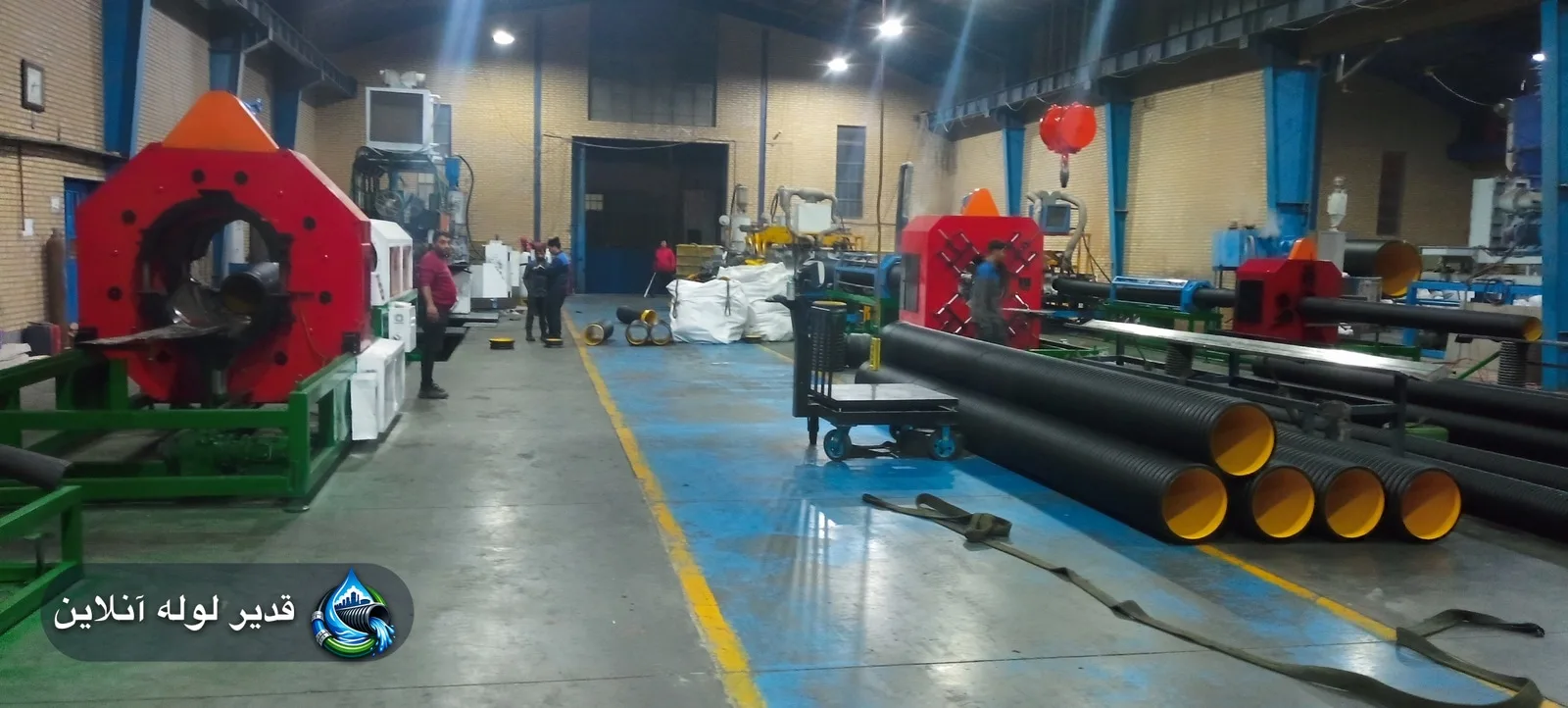
Standard corrugated pipe from the factory
Ghadir Louleh Pasargad double-wall corrugated pipe is produced in Garmsar Industrial Park under the mandatory ISIRI 9116-3 standard licence and an ISO 9001 certificate. See the quality control laboratory and production line on the factory page, and to choose the right class, read the article The difference between SN4 and SN8. Sizes and today's prices are listed on the corrugated pipe page.