 Rubika

What Does the Price of a Polyethylene Manhole Depend On?
Introduction
A polyethylene manhole is an access and inspection point in underground networks, used to connect, inspect and maintain sewer lines, surface water lines and some municipal utilities. For managers of civil and building projects, choosing this component is not just a simple purchase, because every decision at the estimating stage affects the budget, construction time and coordination with the other parts of the project. If the price of a polyethylene manhole is not assessed accurately and on the basis of real factors, the initial estimate may drift away from the final cost and disrupt project planning. In this article, we examine the most important factors that change the price of a polyethylene manhole so that you can make a more informed decision when requesting quotes and comparing them.
Factors Affecting the Price of a Polyethylene Manhole
Raw Material Quality
Raw material quality is one of the most direct factors in the price of a polyethylene manhole. When the manufacturer uses polyethylene with better purity and stability, the manhole body behaves more reliably under soil pressure, moisture and temperature changes. This usually raises the cost of the materials and consequently affects the final price.
In civil engineering projects, this difference is not seen only on the price tag; it also shows up in durability and maintenance. For example, if the manhole is installed where there is more machinery traffic or lateral soil pressure, using a weaker raw material can later cause deformation of the body or a shorter service life. In such conditions, the cheaper choice at the start may end up more expensive in repair or replacement costs.
Production Process
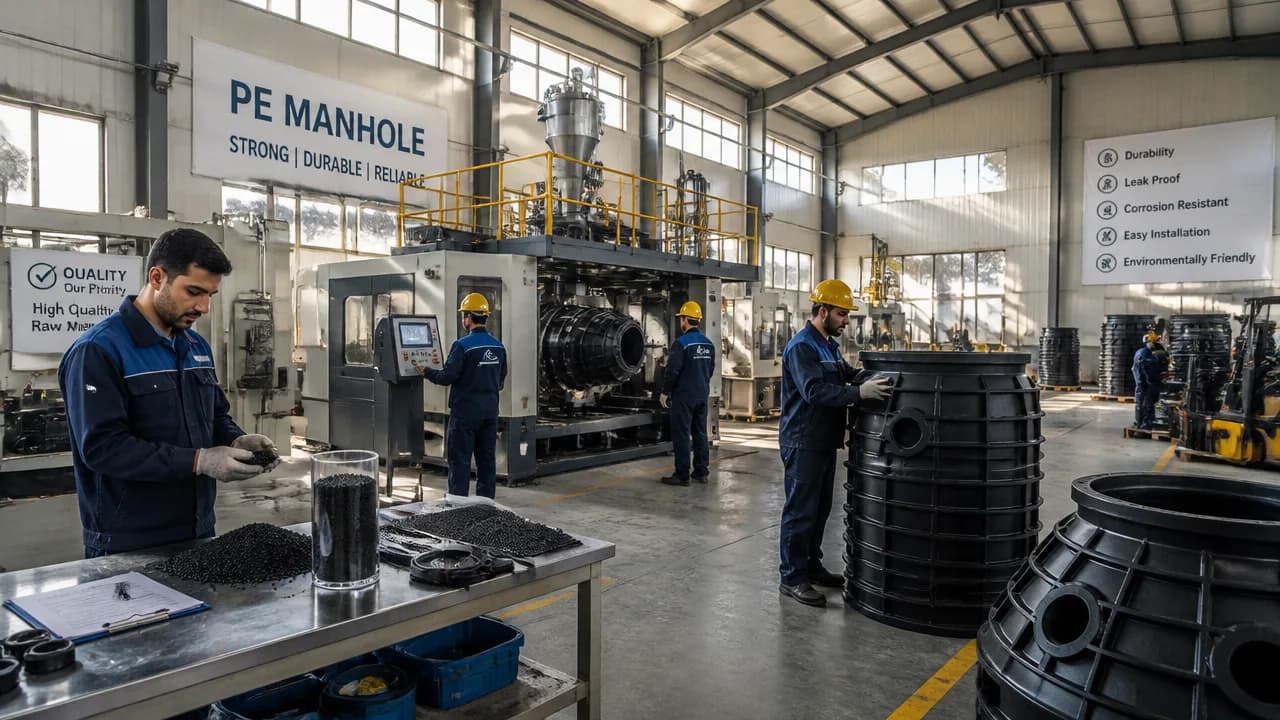
The production process also plays an important role in determining the price. The type of molding, the precision of joining components, the uniformity of wall thickness and the level of quality control all affect the manufacturing cost. The more time and labor the manufacturer spends to achieve a more precise and more standard product, the higher the finished cost.
For example, a manhole produced with tighter control over welding or the connection of inlets usually provides better watertightness and is more suitable for sensitive applications. But this production precision increases the manufacturing cost compared with a product made with a simpler process and more limited control. Therefore, when requesting a price, you should not compare only the appearance of the product; the production method and the quality of the output also matter.
Order Volume
Order volume is another factor affecting the final price. In small orders, the costs of production, packaging, transport and preparation are usually spread over a small number of products, which raises the unit price. But when an order is placed in larger quantities, the manufacturer can plan materials, production time and transport better and manage part of the costs on a larger scale.
In building or civil engineering projects where several manholes are installed on one site, this becomes more important. For example, if a project needs only one or two manholes, the unit price usually differs from bulk orders, because the cost of setting up the production line and preparing the order is spread over fewer units. For this reason, when estimating the budget, the project manager should specify the required quantity accurately and request quotes based on actual consumption.
In practice, order volume does not affect only the unit price; sometimes it also changes payment terms, delivery time and even packaging. Therefore, when comparing offers, you should see for what order quantity and under what terms each price was given, so that you can assess the final figure correctly.
Comparing Prices on the Market
Reviewing Prices on the Domestic Market
To compare the price of a polyethylene manhole correctly on the domestic market, looking only at the final figure is not enough. One seller may quote a lower base price but in practice add transport costs, fitting types, wall thickness, number of inlets and custom production terms separately. As a result, two offers that look close may differ significantly in the final total.
On the domestic market, it is better to compare prices against identical specifications; that is, assume the same diameter, height, cover type, number of branches and installation location. For example, if you get two quotes for a municipal sewage project, one for a ready-made manhole and the other for a custom manhole with more inlets, comparing them directly is misleading. In this case, the second offer is not necessarily more expensive; it is simply designed for a different job.
Price Fluctuations on the Global Market
The global market affects the price of polyethylene manholes directly and indirectly, because raw materials and some production equipment come from a wider supply chain. When the cost of polymer materials, international shipping or access to ancillary parts changes, this fluctuation is also passed on to the domestic market. For this reason, prices may not remain stable over a short period, and old quotes may no longer be a reliable basis.
The reason for these fluctuations is not only the price of raw materials. Changes in freight rates, supply constraints, delivery times and even ordering conditions can shift the final price. Therefore, if your project has a tight schedule, it is better not to rely only on the quoted rate and also ask about the delivery time and the validity of that price. Otherwise, supply delays can push the project's construction cost above the initial estimate.
The Role of Supply and Demand
Supply and demand is one of the most decisive factors in pricing. When the number of orders in civil engineering projects rises and production capacity or warehouse stock is limited, sellers usually have the upper hand in pricing. Conversely, if manufacturers have sufficient stock and competition among suppliers increases, the buyer has a better chance of getting a more favorable price.
This is seen more at peak times for project construction. For example, if several projects need to buy manholes at the same time, some manufacturers quote longer delivery times or raise prices, because demand has exceeded available capacity. In such conditions, the project manager should not focus only on the raw figure, but should check whether that price really matches market conditions, stock and delivery time. This simple assessment prevents costly decisions at later stages.
The Role of Raw Material Quality in the Price of a Polyethylene Manhole
Types of Raw Materials
Different grades of polyethylene are usually used in the production of polyethylene manholes, and this difference in raw material accounts for a large part of the price difference. The more uniform, stable and suitable the raw material chosen for the body is for withstanding site and environmental conditions, the higher the final cost usually is.
On the market, not all materials are the same. Some manufacturers use virgin materials, while others use more economical blends in part of the production process. The main difference is not just in the name of the material; melt quality, wall uniformity, impact resistance and the product's behavior over time also depend on this choice. For this reason, two manholes that look similar may in practice have completely different prices and performance.
Effect of Quality on Price
Raw material quality does not affect only the invoice figure; it also has a direct effect on the project's durability, reliability and later costs. If the raw material is of lower quality, the price of the polyethylene manhole may appear lower, but the risk of warping, damage in transport or a shorter service life increases. In civil engineering projects, these risks usually end up costing more than the initial savings.
For example, if a municipal project needs a manhole to be installed on a traffic route or in difficult soil conditions, choosing a product with weak raw material can later lead to repair, replacement or work stoppages. Conversely, paying more for a more reliable raw material often means fewer construction and maintenance headaches. So when you review the price list, do not look only at the final figure; see what quality of raw material that price comes with.
Comparing Material Quality Across Brands
Different brands usually do not perform equally in raw material selection, production control and quality consistency. Some brands provide more uniform output in every production batch, while others may have lower prices but show more variation in product quality across different orders. For the project manager, this difference is even more important than the price itself, because quality variation makes installation and operation planning difficult.
It is best to compare brands on three criteria: quality consistency in previous orders, transparency in stating raw material specifications, and how well the price matches the product's level of reliability. In practice, the more reputable brand is not always the cheapest option, but it usually creates less risk for the project. If two offers are close in price, the brand with more reliable raw material and more uniform output is the more reasonable choice, even if the initial figure is slightly higher.
Ways to Reduce the Cost of Buying a Polyethylene Manhole
Bulk Purchasing
Bulk purchasing is one of the most direct ways to control the price of a polyethylene manhole, but it only works when you have estimated the project's needs accurately. When the number of manholes, diameter, height, inlet and outlet types and accessories are specified in advance, the supplier can offer a unit price based on a more complete order and allow less for the costs of fragmented production, transport and coordination.
For civil engineering projects where several manholes are installed on one site, consolidating the order is usually more economical than buying in stages. Suppose a building project is carried out in two phases; if each phase is purchased separately, the unit price may rise and transport and delivery costs may be charged twice. Conversely, if the needs of the whole project are specified from the start and quoted together, the chance of getting a better offer increases.
Of course, bulk purchasing is only cost-effective if you also take storage, construction time and possible design changes into account. If the order exceeds actual needs, the cost reduced on paper is offset in practice by tied-up capital or extra storage.
Comparing Prices from Different Suppliers
For a correct comparison, do not just put the final figures side by side. You need to see what specifications each supplier has priced: manhole dimensions, body thickness, fitting types, transport services, payment terms and delivery time. Two offers may appear close, but one may include all items while the other charges some costs separately.
The best approach is to send a standard inquiry form to all sellers so that the responses are comparable. When all suppliers quote based on common specifications, identifying the right option becomes simpler. At this stage, do not just choose the lowest figure; the supplier's track record, transparency in technical specifications and ability to deliver on time also matter.
If the price difference is large, ask for the reason. Sometimes the difference comes down to raw material quality, production method or after-sales service, and sometimes simply to the pricing method. This simple check prevents a purchase that later creates higher costs during construction.
Using Free Consultation
Free consultation when buying a manhole is not just a general conversation; if used correctly, it can prevent a wrong order. Many buyers, because of choosing the wrong dimensions, manhole type or number of covers, later have to modify or replace them, which raises the final cost.
In a good consultation, the project specifications, installation location, type of application and construction constraints are reviewed so that a more suitable proposal can be offered. For example, if the installation site has limited access or the delivery must follow a specific route, the advisor can give guidance on more suitable dimensions or more precise delivery arrangements and help avoid extra costs.
Consultation also helps you see the price alongside performance, not just as a number. When you know what advantage each option has for your project conditions, decision-making becomes faster and more reliable, and the likelihood of paying for unnecessary features decreases.
Conclusion
In summary, the price of a polyethylene manhole does not depend on a single fixed figure; the manhole's dimensions and depth, type of application, body thickness, raw material quality and order conditions all affect the final figure. For this reason, comparing prices without considering technical specifications and the project's real needs usually leads to an imprecise choice and hidden costs.
For project managers, the most important point is to choose a manhole that is both compatible with construction conditions and able to withstand pressure, moisture and long-term operation. The cheaper choice is not always more cost-effective; if the product does not match the project's needs, it will impose higher costs during installation or operation.
If you are looking for a reference for more accurate quotes, reviewing purchase options and access to reliable sources for product pricing and buying pipes and fittings, you can use ghadirlouleonline.ir. This website can be a good starting point for more informed comparison and a more suitable choice.