 Rubika

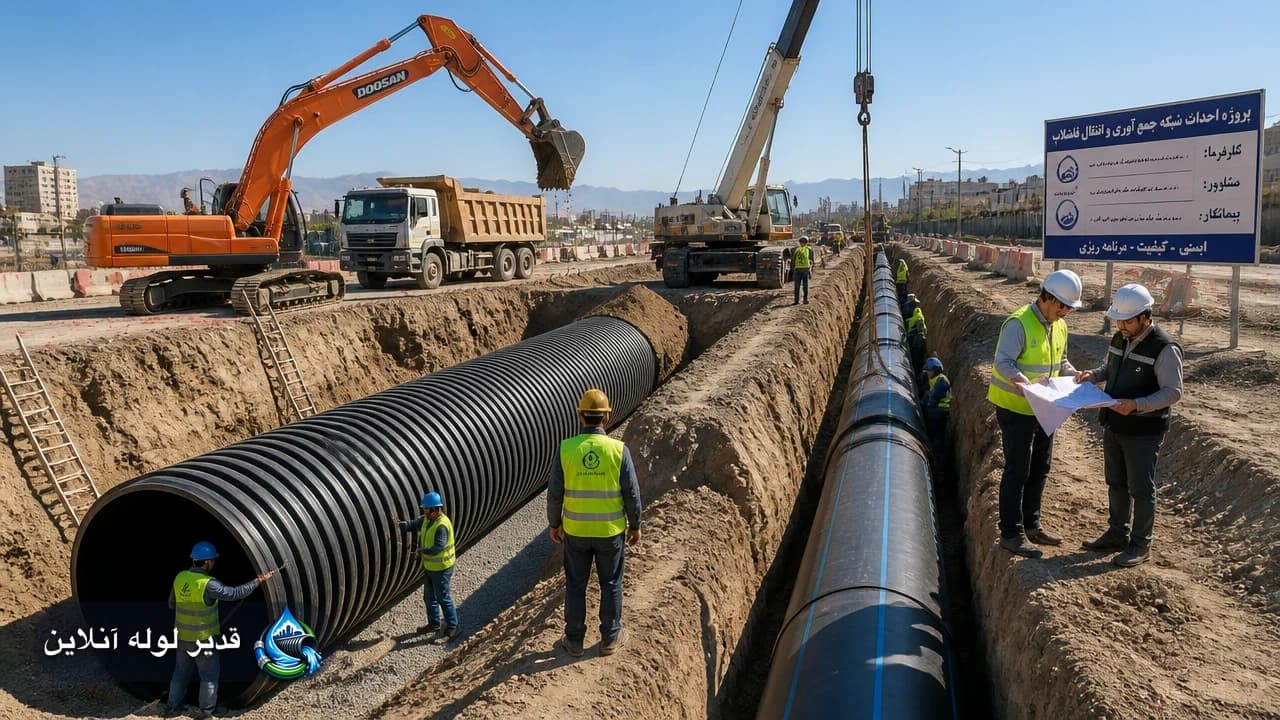
Corrugated Pipe or Polyethylene: Which Is Better for Sewage?
Introduction
Choosing pipe for a sewer network is not just a simple purchase; it is a decision that affects watertightness, line durability, installation cost and even later operating headaches. If the pipe material does not match the soil conditions, burial depth, type of fluid and installation method, the project will soon face leaks, settlement or repeated repairs.
Among the common options, corrugated pipe or polyethylene attracts the most attention, because each is better suited to particular conditions. The difference between the two is not only in appearance or wall material; structure type, jointing method, mechanical strength and installation method also play a role in the final choice.
In this article, we examine these differences in practical terms so that you can choose the option for your sewage project that better matches your technical and construction requirements.
Advantages and Disadvantages of Corrugated Pipe
Advantages of Corrugated Pipe
Thanks to its corrugated wall structure, corrugated pipe performs reliably against external pressures and impacts caused by soil load or surface traffic. This property becomes more important in projects where the pipe is buried deep or where heavy vehicles travel over the route. In such conditions, the mechanical stability of the pipe does not depend only on its material; the geometric shape of the wall also plays a decisive role, and corrugated pipe scores well in this respect.
Another important advantage of this pipe is its light weight compared with many traditional options. This makes transport simpler and speeds up handling of the pipes on sites where machinery access is limited. For example, in an urban sewage project where the route is narrow or busy at several points, the light weight of the pipe can reduce the time needed for unloading, moving to the installation point and preparing the bedding. This advantage also helps reduce construction pressure on long-route projects.
Corrugated pipe is also a suitable choice in certain geographic conditions, especially where there is unstable soil, ground settlement or localized pressures. Its relative flexibility and good behavior under controlled deformation reduce the risk of damage on routes where a uniform installation bed is difficult to achieve. For this reason, contractors in some urban areas or on routes with variable soils consider corrugated pipe the more practical option.
Disadvantages of Corrugated Pipe
The most important limitation of corrugated pipe is its higher cost compared with some other common pipes. This price difference does not relate only to the pipe itself; sometimes the type of fittings, the need for greater care during installation and specific project requirements also raise the final cost. When the project budget is limited, this difference can directly affect the decision.
On the other hand, if the project is carried out where installation quality control is weak, the advantages of corrugated pipe will not be fully realized. This pipe needs proper bedding, accurate grading and attention to installation details to perform correctly. On routes where backfilling or compaction around the pipe is not done with sufficient care, part of its mechanical capacity effectively goes unused.
It should also be noted that corrugated pipe is not always the best choice for every type of sewage. In projects where the main priority is initial cost savings or very simple installation conditions, other options may be more reasonable. Therefore, when choosing between corrugated pipe or polyethylene, you should not rely only on apparent strength or market popularity; the actual project conditions, the installation site and the budget level should be weighed together.
Advantages and Disadvantages of Polyethylene Pipe
Advantages of Polyethylene Pipe
In sewage projects, especially when budget and installation speed matter, polyethylene pipe is often regarded as an economical and reliable choice. The initial cost of this pipe is usually more reasonable than some other options, which makes it attractive for projects with large pipe lengths. When the volume of pipe laying is high, this cost difference has a significant effect across the whole project.
One of its important advantages is good resistance to corrosion and many chemicals. In a sewer network, the pipe deals with an environment that can be corrosive; therefore, a pipe wall that remains stable against rust and chemical degradation reduces operating problems. This property is particularly important on routes where contact with industrial effluent or aggressive soils is possible.
Installing polyethylene pipe is also usually quicker and simpler. The good flexibility of this pipe means that on some routes fewer fittings and intermediate parts are needed and the work proceeds faster. For example, in a sewage collection project in city streets where the time a route can be closed is limited, high installation speed can directly benefit project management. This is also an important practical advantage for a contractor who has to advance several work fronts at the same time.
Disadvantages of Polyethylene Pipe
Despite its advantages, polyethylene pipe also has limitations that should not be ignored in the final choice. One of the most important is sensitivity to temperature. Sharp changes in ambient or fluid temperature can affect the mechanical behavior of the pipe and call for closer review in projects with unstable thermal conditions. This matters more in very hot or cold regions, or on lines carrying fluid at unusual temperatures.
Another point is sensitivity to UV radiation if the pipe is kept or stored improperly. If the pipe remains outdoors in direct sunlight for a long time, its protection must be taken seriously so that its appearance and performance are not damaged. For this reason, on sites with long-term storage, proper storage management becomes part of the project cost and planning.
From an installation point of view, it should also be noted that although this pipe is quick to install, the quality of welding, jointing and bedding preparation is still decisive. In fact, speed of installation should not lead to complacency in quality control, because a poor joint can diminish the advantages of polyethylene pipe in service. Therefore, when comparing corrugated pipe or polyethylene, this option gives the best result when both the environmental conditions and the installation requirements are carefully assessed.
Comparison of Costs and Durability
Initial and Maintenance Costs
When comparing corrugated pipe or polyethylene, the initial cost is not limited to the price of the pipe itself. Weight, joint type, installation speed, the need for installation equipment and even the number of joints all affect the final budget. Corrugated pipe is usually seen as more economical in terms of transport and handling, and in some projects in terms of supply and installation, especially when the route is long and reducing material weight matters. On the other hand, if the project requires more precise joints, more construction details or stricter control, installation costs can rise.
Polyethylene pipe usually has installation advantages that may make the initial cost seem more justifiable, such as greater continuity along the line and a lower chance of leakage at the joints, provided installation is done carefully. However, if the choice is made without regard to ground conditions and applied loads, later maintenance costs will rise. In an urban sewer network, for example, if the route passes through unstable soil or areas prone to settlement, the money saved on purchase today may later be offset by repeated repairs.
In terms of maintenance, the costs of periodic inspection, clearing blockages, repairing joints and accessing the route must also be considered. A pipe that is cheaper at the installation stage is not, overall, the better economic choice if in operation it requires the route to be repeatedly opened up or the gradient to be corrected. Therefore, cost analysis should consider the full project life cycle, not just the purchase invoice.
Durability and Service Life of Each Pipe Type
Pipe durability does not depend on a single factor; it involves a combination of material quality, burial conditions, type of loading, installation method and even bedding quality. In corrugated pipe, the ring structure is very important for carrying external load; but if backfilling around the pipe is not done properly or the bedding is not sufficiently compacted, that same mechanical advantage is reduced in practice. Polyethylene pipe, in contrast, shows good durability when welds, joints and bedding have been carried out carefully.
In projects with temperature fluctuations, ground movement or continuous traffic loading, installation quality becomes more decisive than the type of pipe. For example, on a route where localized settlement is possible, a pipe with greater flexibility but a weak joint may fail sooner, while a pipe with a more reliable joint but poor bedding will be damaged at another point.
The service life of both pipe types is maximized when the project is designed and built based on actual conditions; that is, soil type, burial depth, surface load and installation quality are reviewed from the outset. Consequently, durability should not be attributed to pipe material alone. In choosing between corrugated pipe or polyethylene, the winner is the pipe that, in addition to manufacturing quality, better matches the project's construction conditions.
How to Install and Maintain the Pipes
Corrugated Pipe Installation Guide
Installing corrugated pipe depends more on bedding preparation and accuracy in grading and jointing than on the pipe itself. In gravity sewage projects, if the bedding under the pipe is not uniform, soil pressure is applied asymmetrically and the likelihood of localized deformation increases. That is why leveling the trench bottom, removing sharp stones and placing a suitable bedding layer are key installation steps.
When jointing the pipes, the method and accessories recommended for that system must be used. If the joints are not properly sealed, leakage or groundwater infiltration occurs at the joint, which affects the performance of the whole line. When selecting corrugated pipe, care must also be taken that the diameter, strength class and joint details match the project conditions, rather than deciding only on the basis of what is available on the market.
Polyethylene Pipe Installation Guide
During installation, polyethylene pipe is more sensitive to weld quality and the preparation of the jointing surfaces. If butt welding or similar methods are to be used, the two pipe ends must be clean, aligned and undamaged. Any small deviation in alignment later leads to stress concentration at the joint. In sewage projects where pressure or temperature changes are a factor, these installation details play a major role in line stability.
During installation, work scheduling, ambient temperature and operator skill must also be taken into account. A pipe that has been welded correctly but placed on unsuitable bedding will not perform acceptably in practice. Following installation standards is not just a paper requirement, because it prevents localized settlement, warping and damage to the joints. For example, on a site sewage line where the trench was left without compacting the surrounding layers, ground settlement after a few months placed extra stress on the joints and the route had to be reopened.
Maintenance and Care Tips
Proper maintenance of both pipe types starts at the operation stage, not only after a failure occurs. Periodic inspection of manholes, checking for leaks at joints and monitoring ground-surface settlement along the line are among the simplest tasks that can prevent costly failures. If heavy vehicles or repeated loads pass over the route, changes in the ground surface should be followed up more seriously.
To extend service life, impacts during unloading and loading, as well as improper storage of pipes, should be avoided. Sediment build-up in sewer lines, if not dealt with in time, also creates hydraulic pressure and localized blockages. Periodic flushing, checking joint locations and recording the condition of the route during regular inspections help identify problems at an early stage, before they lead to widespread damage or a shutdown of operation.
Suitable Applications for Each Pipe Type
Applications of Corrugated Pipe
Corrugated pipe is a suitable choice when the project requires high ring stiffness, fast installation and economical management of long routes. These pipes perform well in gravity sewage lines, surface water collection networks, drainage channels and routes with standard backfilling and bedding. If the route is not straight or the pipe-laying length is large, lower weight and ease of handling can make the work simpler.
In many urban projects, corrugated pipe is chosen for sewage collection networks in streets, on city outskirts and in areas with controlled traffic, provided that the bedding design and burial method are carried out correctly. For example, in a project to convey sewage from a newly built neighborhood, when the route gradient is suitable and the surrounding soil requires a pipe that can bear soil and traffic loads, corrugated pipe can be a practical option. In this type of project, installation speed and the ability to cover long lengths with fewer components are important advantages.
However, when the route has heavy loading, uncertain soil conditions or high sensitivity to watertightness, joint details and bedding must be reviewed more carefully. Therefore, choosing corrugated pipe does not depend only on the pipe's name; soil type, burial depth, installation quality and the need for reliable sealing determine how suitable this option is.
Applications of Polyethylene Pipe
Polyethylene pipe is used more in projects where continuous watertightness, route flexibility and greater joint reliability are important. This pipe is suitable for lines where minor route changes, ground settlement or the need for continuous, leak-free installation are a factor. In pressurized sewage, pumping stations, intermediate transmission lines and sections where leak control is particularly important, polyethylene is the more reliable choice.
In industrial projects or urban facilities where a transmission line has to cross several obstacles, polyethylene simplifies the work because it allows continuous installation and better tolerates installation stresses. For example, if a sewage route has to pass through an area with heterogeneous soil or possible localized settlement, polyethylene pipe can reduce the risk of damage at the joints. This property matters more in projects where downtime or leakage is costly.
When choosing between corrugated pipe or polyethylene, you should first determine whether your system is gravity or pressurized, how much settlement or deformation the route is subject to, and how sensitive the project is to leakage. If the priority is installation speed for a gravity network and savings in installation, corrugated pipe is usually more reasonable. If line continuity, watertightness and route flexibility are the priority, polyethylene will be the more suitable choice.
Quality Standards and Certificates
International Pipe Standards
Standards play a decisive role in choosing corrugated pipe or polyethylene, because they do not just name the product; they show what level of quality the pipe must meet in terms of dimensions, material, test method and performance. In sewage projects this is particularly important, because a wrong choice can lead to leakage, deformation under soil load or reduced performance during operation.
In practice, recognized standards usually focus on several main areas: mechanical strength, joint watertightness, resistance to sewage chemicals and consistency of production quality. For polyethylene and corrugated pipes, compliance with recognized international standards and periodic testing help the buyer make sure the product is not just suitable in appearance but also behaves predictably under actual project conditions.
The important point is that simply printing a standard's name on a sales sheet is not enough. You need to see exactly which part of the product that standard covers; for example, whether it covers only the raw material, or also the joint, the smoothness of the inner surface, external load capacity and factory quality control. For a sewage collection network, it is these details that make a difference in final performance.
The Role of Certificates in Choosing the Right Pipe
Certificates help you measure the manufacturer's claims against a verifiable reference. A valid certificate usually shows that the product has passed specified tests, its production process has been under control and its technical specifications are consistent with the declared standard. This is very important for the contractor and the site engineer, because at the time of purchase they do not rely only on a brochure or a verbal explanation.
When choosing pipe, it is better not to settle for the label "quality certified". You should check whether the certificate relates to the product itself or merely refers to the factory's management system. In addition, the availability of test reports, a technical data sheet, production batch traceability and delivery documents that match the order specifications are signs of a more serious supplier.
For example, in an urban sewage project, if the contractor is undecided between two offers, the product with clearer conformity documents that provides tests related to ring stiffness, watertightness and material durability is the safer choice, even if there is a price difference at first glance. Such a choice reduces the risk of rework, early replacement and disputes at handover.
To sum up this section, when reviewing standards you should answer three questions: what exactly the standard covers, which body issued the certificate, and whether its technical documents match the actual needs of the project. If these three points are clear, the decision about corrugated pipe or polyethylene will be based on real quality, not merely on the seller's claims.
Conclusion
Choosing between corrugated pipe or polyethylene is not just a comparison of two pipe materials; in practice, the type of sewer network, the loads on the line, soil conditions and installation sensitivity determine which option causes fewer problems in operation. If the pipe is not chosen correctly, problems such as leaks at joints, reduced performance on long routes or installation difficulties can raise project costs and delay handover. For this reason, the final decision should be based on the project's real needs and not merely on appearance or initial price.
If you are looking for a reliable route to supplying quality pipes, Ghadir Louleh Online services, with a focus on supplying pipes and fittings, can make selection and purchasing simpler. At ghadirlouleonline.com you can explore options better suited to your sewage project's specifications and get advice on the product's suitability for your installation conditions before buying. For a more precise selection and reliable supply, visiting the website or getting a consultation can be your next step.