 Rubika

Introduction
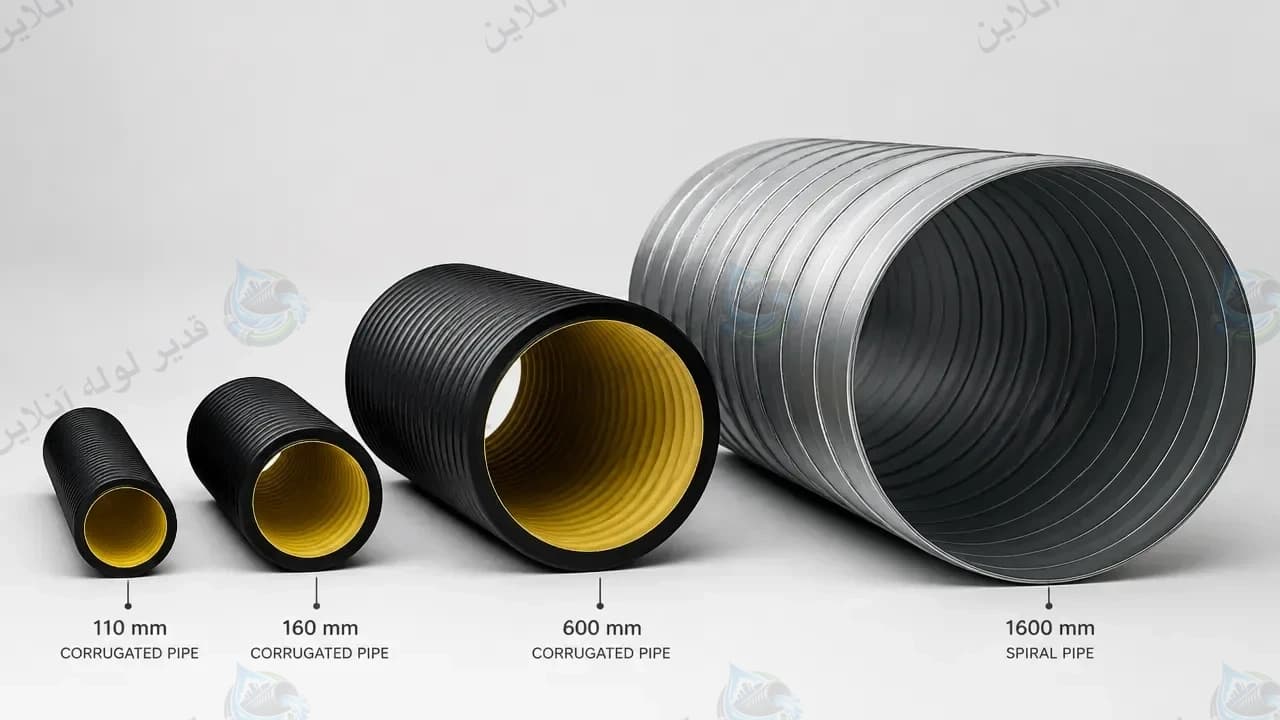
Suppose you are looking for pipe for your project and are undecided between several different diameters. In such a purchase, comparing the 110 mm double-wall corrugated pipe from the outset helps you understand which diameter suits which project scale. It also clarifies when you should opt for a larger size.
Below, we review several options available in this store one by one so the typical application of each becomes clear. The main difference between them mostly comes down to diameter. It is also related to project scale. A short comparison table near the end places them side by side to simplify your decision.
Products covered in this article:
- 110 mm Double-Wall Corrugated Pipe
- 160 mm Double-Wall Corrugated Pipe
- 600 mm Double-Wall Corrugated Pipe
- 900 mm Spiral Pipe
- 1600 mm Spiral Pipe
- Quick Comparison Table
110 mm Double-Wall Corrugated Pipe — Cost-Effective for Small Projects
The 110 mm double-wall corrugated pipe 110 mm double-wall corrugated pipe is the most affordable option in this group. It is a more logical choice for small, low-budget projects. When the sewer run is short or the water and wastewater flow is not high, this size can get the job done at lower cost. It has an outer diameter of 126 mm and is available in SN4 and SN8 classes. So you have more flexibility to choose based on your project requirements.
If budget matters to you and you are not dealing with heavy-duty runs, this model is more suitable. This pipe is a good choice for sewerage in small buildings, limited service connections, and routes where the pipe is not subjected to high loads. An EPDM seal is also used for water-tightness. During installation, make sure the joints seat properly, because in double-wall corrugated pipes this small detail greatly affects the quality of the work.
Compared with the 160 mm double-wall corrugated pipe, this model is more compact and more economical. However, for routes that require higher flow capacity, it cannot replace the larger option. If your project is still at the service-connection or branch-line stage, this size is usually the easier choice. Buying directly from the factory is also an important point for anyone who wants to order in larger quantities. Just check the route length and fitting type against the construction drawings before ordering so you do not run into problems on site.
160 mm Double-Wall Corrugated Pipe — Suitable for Medium Projects with Greater Capacity
What exactly do you need from a 160 mm double-wall corrugated pipe? If your answer is more capacity than the smaller size at a reasonable cost, the 160 mm double-wall corrugated pipe is usually a well-balanced choice. This model is available in SN4 and SN8 classes. Its outer diameter is 184 mm. Therefore, for routes that need something larger than the 110 mm pipe but do not yet call for very large sizes, it makes more sense.
This size is mostly suited to medium-scale residential and commercial projects. If your route passes through several service connections, this model can handle surface-water collection. It is also suitable for conveyance within a small workshop. In terms of accommodating flow and managing execution, it gives you more room. On the other hand, compared with the smaller size it provides more space, and compared with larger sizes it is more compact and usually simpler for routine building work. An EPDM seal is also included in this model, and for a proper connection you should check the seal's integrity and correct seating right from the start.
In terms of positioning, this pipe falls in the mid-range. It is not so small that it limits you quickly, nor so large that it seems excessive for typical projects. That is why, when you want more capacity but do not want to go for heavier options, it is a balanced choice. Buying directly from the factory also makes things easier for anyone picking up several lengths for a single project. Order coordination and shipping throughout Iran proceeds more smoothly. Just review the route length and fitting type against the construction drawings before purchasing. Even in this size, if the route has many bends, selecting the right fitting becomes important.
600 mm Double-Wall Corrugated Pipe — Suitable for Large and Industrial Projects
The 600 mm double-wall corrugated pipe is one of those models chosen for larger routes. The diameter of this pipe is suitable for conveying higher volumes. It is also treated separately for heavier-duty applications. If you are looking for a 600 mm double-wall corrugated pipe, this option is typically useful when smaller pipes can no longer handle the main line. In that case, you need greater confidence in the structural durability.
This model makes more sense for large and semi-industrial projects. For example, when you are running a sewer line, the larger diameter helps keep the flow smoother. It also reduces the working pressure on the pipe. For this reason, if your project is not a branch or low-volume type, this size is a more logical choice than the smaller models. On the other hand, for tight spaces or light-duty work, it is an oversized choice. You should inspect the installation site carefully before ordering.
In terms of positioning, this model sits in the middle of the range — it is not in the most economical group of smaller sizes, nor in the very large, specialized category like the 900 mm spiral pipe. This positioning makes it a viable option for anyone seeking a balance between capacity and final cost. If your project has not yet reached the scale of the very large models but has outgrown 160 mm, this choice is usually seen as more logical.
An EPDM seal is also listed in this model's specifications, which is important for water-tightness. However, before purchasing you must match the SN4 or SN8 class to your site conditions. Pressure and environmental loads differ from project to project. Remember to check the 693 mm outer diameter against the construction drawings as well. This helps ensure you have enough space at the joint location for positioning and fastening. If your route is long or several segments need to sit next to each other, this simple coordination prevents installation headaches.
900 mm Spiral Pipe — Suitable for Sewer and Water-Supply Systems
Suppose you are working on a main sewer or water-supply line in a large compound and flow volume matters more to you than a compact pipe. For such work, the 900 mm spiral pipe is more suited to your needs. This pipe is designed for routes that must handle high-volume flow and retention more comfortably.
This model is a spiral pipe type and is also available in SN4 and SN8 classes. So if your project needs a reliable line for a sewer collector, stormwater route, or culvert, you can seriously consider this size. For large-scale building and civil-engineering projects, the pipe diameter must match the flow volume. Under these conditions, 900 mm gives you more peace of mind than smaller options. However, it is not a suitable choice for small branch lines.
In terms of positioning, this model also falls in the mid-range. It is not like the smaller pipes intended for lighter work, nor like the larger models aimed at very high-volume projects. For this reason, if your project has moved past the service-connection stage and now requires a high-capacity main line, this pipe is a more balanced choice. On the other hand, if the installation space is tight or the route has several sharp bends, you should check the execution details carefully before purchasing.
Buying directly from the factory is also an important consideration for anyone who is particular about parts coordination and execution scheduling. It is best to specify the fitting type and route gradient before ordering. Also, verify how the pipe will connect to the collector or the next section of the network against the construction drawings. This helps you avoid needing a design change in the middle of installation.
1600 mm Spiral Pipe — For Large-Scale Projects
The 1600 mm spiral pipe is self-explanatory from its name: a very large-diameter pipe for heavier-duty applications. If your project involves sewer collection, stormwater conveyance, or culvert construction on a large scale, the 1600 mm spiral pipe should be on your radar. This model is for situations where capacity and durability outweigh ease of installation or simple cost savings.
This pipe is mostly suited to large sites, main routes, and projects where the working load on the line is high. When the flow volume increases, choosing a larger diameter makes more sense because it keeps the route open for smoother conveyance. For this reason, if your project is secondary or limited in scope, such a model is usually not a sensible choice and will cost more than you need.
In terms of positioning, this model sits at the top of the range and is the most expensive option among the products in this comparison. This means it is mostly selected for specialized, large-scale projects rather than routine building work. If you are undecided between this model and smaller sizes, you need to assess whether ordinary water passage is sufficient for you or whether you truly need high capacity and a body better suited to demanding conditions.
This product is available in SN4 and SN8 classes, so at the time of purchase you must match the appropriate class to your site conditions. If your route is subjected to traffic loads, heavy backfill, or higher execution pressures, take the class selection seriously. Also, because this model is designed for large dimensions, be sure to check transport clearance, on-site fit, and fitting type against the construction drawings before ordering. If this pipe is to be installed next to a tank or main channel, plan the inlet and discharge path precisely. This helps you avoid running out of space on site.
Comparing the 110 mm Double-Wall Corrugated Pipe: Quick Comparison Table
| Product | Specifications |
|---|---|
| 110 mm Double-Wall Corrugated Pipe | Most affordable option for small, low-budget projects |
| 160 mm Double-Wall Corrugated Pipe | Medium projects requiring greater capacity |
| 600 mm Double-Wall Corrugated Pipe | A practical option for large and industrial projects |
| 900 mm Spiral Pipe | Large sewer and water-supply systems |
| 1600 mm Spiral Pipe | Most expensive option in this comparison |
If you want to decide among these models, it is better to shift your focus from the product name to the diameter and project scale. Smaller pipes fall into the more economical group, and as the diameter increases so does the cost, because they are made for larger projects and higher flow. In this context, comparing the 110 mm double-wall corrugated pipe with larger sizes mostly comes down to this difference, not to a difference in appearance.
So if your route is shorter and your budget is more limited, smaller sizes usually suffice. But when the flow volume increases or the project is larger, a bigger diameter is the safer choice. A simple rule is this: assess today's need, not just the number on the pipe. If flow capacity matters more, go for the larger diameter; if cost savings matter more and the work is lighter, the smaller size is sufficient.
Which One Should You Choose?
If you are stuck between these five options, start from the project scale, not the product name. First determine how much flow volume there is and how much load your route will bear. Then consider the budget, and finally evaluate installation. This sequence ensures you buy an option that will not fall short later or exceed your actual needs.
Project requirements: If your work involves light service connections, short routes, or confined spaces, the 110 mm double-wall corrugated pipe is usually the more compact choice. If the route is somewhat wider and you need more flow capacity, the 160 mm double-wall corrugated pipe becomes more logical. For larger projects, the 600 mm double-wall corrugated pipe is a suitable option. Additionally, the 900 mm spiral pipe and the 1600 mm spiral pipe are recommended for higher capacity and more demanding routes.
Budget: After defining your requirements, look at your cost range. A common mistake is choosing only the cheapest option and then being forced to re-purchase or reroute during execution. If your project is small, the 110 or 160 model usually puts less pressure on the budget. If the project is larger, it is better to go for a size that matches your work from the start, even if the selection is harder.
Installation: Easy installation is not solely related to pipe diameter, but a smaller diameter usually means simpler handling and layout. If the work site is a workshop or a tight space, this point becomes important. Conversely, for larger projects you must also plan for transport clearance, positioning, and connections in advance. Sometimes a buyer only thinks about diameter and forgets that a larger pipe requires more labour and more precise coordination during execution.
If you want to decide very briefly, first define the capacity, then finalize the budget, and lastly check ease of installation. These three steps together make your choice more precise and prevent a hasty purchase.
Comparing the 110 mm Double-Wall Corrugated Pipe: Summary and Final Selection
If your project is small and you want to keep costs down, the 110 mm double-wall corrugated pipe is a compact choice. This size causes less hassle for branch routes and low-volume work, and installation proceeds more simply. If you know from the outset that the flow volume is higher, it is better to go for 160 mm. For larger work, the 600 mm, 900 mm, and 1600 mm pipes are each built for heavier demands and make sense in broader-scope projects. So when comparing the 110 mm double-wall corrugated pipe, your main criteria should be budget, flow capacity, and ease of installation. If you are still undecided between several diameters, lay out your project specifications side by side and then evaluate the options.