 Rubika

Introduction
Suppose you need to choose correctly among several options for a sewage project. In that situation, corrugated pipe comes into the picture when you want the right diameter, durability, and a cost that fits the project budget.
This guide is for you if you want to see the differences between the options clearly before buying, rather than deciding on the pipe's appearance alone. Below, we review the options in this store one by one, so you can compare everything from the economical models to the larger ones side by side.
Each section focuses on a simple point: size, resistance to load, and ease of installation. If you weigh these three together, it becomes much easier to see which pipe suits your job best.
Near the end, you will also find a quick comparison that places the options side by side. It speeds up your decision, so you do not get stuck between several similar choices.
Products in this article:
- Corrugated pipe 110mm
- Corrugated pipe 160mm
- Corrugated pipe 250mm
- Corrugated pipe 600mm
- Corrugated pipe 1000mm
- Quick comparison table
Which pipe suits the size of your project
How do you match dimensions with flow capacity?
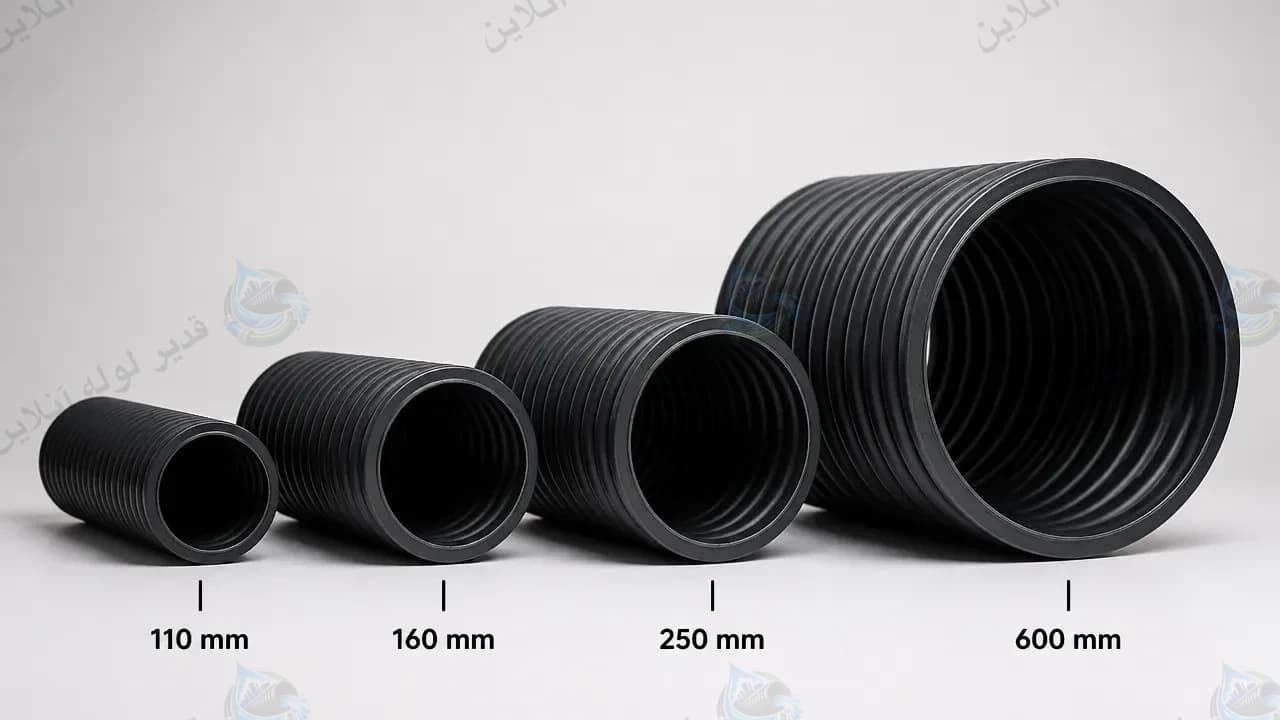
First of all, assess the size of the project against the volume of wastewater that will pass through the pipe. For a small unit with a short route and limited consumption, the 110 mm corrugated pipe is usually a compact choice. If your project has several branches or a somewhat larger workload, the 160 mm corrugated pipe gives more room for flow.
When the project grows beyond this, diameter needs to be taken more seriously. A 250 mm pipe is better suited to routes carrying heavier flow. This size makes flow easier and gives you more flexibility in building or site works. For heavier sewage loads, the 600 mm and 1000 mm pipes are mostly used in industrial projects or special applications. Here, a large diameter is the main priority.
A common mistake is to think only about diameter and ignore the length of the route. The longer the route and the more bends it has, the more important the right diameter becomes. Otherwise, installation gets harder and the joints cause more trouble later on.
How do you estimate pipe diameter based on the sewage load?
If your project is small, a smaller diameter usually works, but you should not choose a pipe so small that pressure on the line rises later. For medium projects, it is better to go for a diameter that is simple to install and does not burden you with extra fittings. As the diameter increases, the fittings and accessories usually become larger and take longer to install.
That is why your choice does not depend on pipe size alone. If the installation site is hard to access, choose a pipe that is easier to handle and join. But if it is the main sewer line and must remain adequate in the future, it is better to choose one size larger to avoid rework. In industrial projects, choosing a larger diameter helps above all with the durability of the line and your peace of mind, not merely with having a bigger pipe.
Corrugated pipe 110mm: an economical option for small projects
If your job is small, is this model right for you? Yes. If you have a short route or need to collect the wastewater of a branch channel, the 110 mm corrugated pipe is a sensible choice. This corrugated pipe is supplied in SN4 and SN8 classes. Its outside diameter is 126 mm. This makes it the more convenient option for jobs that need a smaller diameter and easier handling.
This model is best suited to small projects, branch connections and jobs where flow pressure is not very high. If you are working in a garden, a small site or a low-load route, this size can cover your needs without enlarging the line unnecessarily. When the budget is limited or the job is temporary, this choice keeps costs down. It also saves you from needing a heavier, more expensive pipe.
Among the options in the same family, this model is the lowest-cost choice in the group. If your project is still limited to short branch routes, you usually do not need to move to larger diameters. If more load will pass through the same route later, it is better to size it more carefully now. This helps you avoid having to replace it in the middle of the job.
An EPDM seal is also included in this model's specifications and helps seal the joints. Before buying, be sure to check the route length and number of joints. The more bends a route has, the more important installation accuracy becomes. If you plan to use the pipe for a short branch or a temporary route, coordinate this point with the installation contractor in advance.
Corrugated pipe 160mm: suitable for medium projects that need a larger diameter
Corrugated pipe is known for sewage lines because of its corrugated wall. It is useful where handling must be easy and the pipe wall must withstand load. If your project is somewhat larger than an ordinary house, or you need pipe for a small complex, the 160 mm corrugated pipe offers a larger diameter than the smaller model. Even so, it remains suitable for medium-sized jobs.
This model is a good fit when the sewage line carries more water and you do not want to jump to larger diameters too soon. For example, in a large house or a small complex, this size can strike a good balance between flow capacity and cost. That is why, if your project has gone beyond the basic level but is not yet industrial, this diameter is usually the easier choice.
In terms of positioning, it sits in the middle of the range. In other words, it is a step above the smaller model and a step below the larger one. So if you are looking for an option that is not just cheap but also offers more capacity, this model is a reliable middle ground.
Its specifications list an outside diameter of 184 mm, and it is supplied in SN4 and SN8 classes. Match this with your project requirements before buying. The type of work and the load on the line will change your choice. It also has an EPDM seal. So if watertightness matters to you, carefully check during installation that the seal is intact and the joint area is clean.
If you are buying this pipe for the main part of the network, it is better to recheck the route dimensions and number of joints before ordering. This prevents an undersized diameter or installation problems in the future.
Corrugated pipe 250mm: effective for larger sewage systems
Suppose you need a pipe for a neighborhood or a sewage route with higher-than-usual flow, one that is reasonable to handle yet holds up in serious work. In that case, the 250 mm corrugated pipe is a choice that sits in the middle. It is not so small that it quickly reaches its capacity limit, nor so large that it becomes heavy and cumbersome for your project.
This corrugated pipe model is well suited to neighborhood sewer networks and routes with medium-to-high flow. If you are laying the main line of a building complex, this diameter can be the more logical choice. It can also suit part of a neighborhood network or a drainage route that must remain adequate in the future. The 290 mm outside diameter is another point you should coordinate with the installation space and fittings before ordering. On busy projects, these small details cause trouble later.
In terms of positioning, this model sits in the upper-middle part of its family. That is, if you are moving up from 160 mm and are not yet going to 600 mm, 250 mm is the point people choose for more capacity. This model is also supplied in SN4 and SN8 classes. So when buying, it is better to choose the class that matches the working load and burial conditions of the pipe. The EPDM (ethylene propylene) rubber seal also helps with sealing. But before ordering, make sure the joint type and route length match the construction drawings. A mistake at this stage causes more trouble than the pipe itself.
Corrugated pipe 600mm: suitable for industrial and large projects
The 600 mm corrugated pipe is made for industrial projects and main sewer lines. If you are working on a line that needs both high flow volume and a stronger pipe wall, the 600 mm corrugated pipe is a choice whose application is clear from its name. This model is supplied in SN4 and SN8 classes, so when your line is under greater load, you have more freedom of choice. Its outside diameter of 693 mm also shows that this is not a light pipe for branch work; it should be considered for serious work.
This size is usually useful when you want to lay a main line that is compact and reliable. For example, in industrial sites, sewage collection lines or places where water must be conveyed in larger volumes, this diameter is the more logical choice. The rubber seal also helps the joints close more neatly and securely. This matters especially when the route is long and you do not want to return to the joints later. If installation takes place on straight main routes, this model shows its value most clearly.
In terms of positioning, this pipe sits in the middle of the range, but for large projects it counts among the more costly options. The reason is clear: for this cost you get a pipe wall built for higher load and flow, which would be more than needed for light work. So if your project is small, it is better to go for a smaller diameter to avoid paying extra. If your line is a main, heavily used route, this model is one of those choices that proves its worth through durability and peace of mind. Just make sure before buying that the 693 mm diameter fits the installation space and fittings of that route.
Corrugated pipe 1000mm: suitable for very large and special applications
The 1000 mm corrugated pipe is the most expensive option in this group and makes sense when you need very high capacity. If your sewage line was designed large from the outset, this model can be a more serious choice. Also, if the working load is expected to increase in the future, this pipe, the 1000 mm corrugated pipe, is a suitable option. It is supplied in SN4 and SN8 classes, so you have more freedom to choose based on project requirements.
This model is mostly suited to very large projects and special applications, where a larger diameter and more reliable joints matter more than ease of handling. Its outside diameter of 1185 mm also shows that you are dealing with a pipe built for main lines and heavier work. If your project is industrial or carries a high volume of wastewater, this size can reduce the problems of insufficient capacity.
However, it is better to coordinate it with the route plan and installation method before buying. Because this diameter is large, you usually need to check transport, placement and jointing carefully in advance. This keeps you from being held up on site.
Corrugated pipe: quick comparison table
| Product | Specifications |
|---|---|
| 110 mm corrugated pipe | The cheapest option for small projects |
| 160 mm corrugated pipe | Medium projects that need a larger diameter |
| 250 mm corrugated pipe | A practical option for larger sewage systems |
| 600 mm corrugated pipe | Industrial and large projects |
| 1000 mm corrugated pipe | The most expensive option in this comparison |
Corrugated pipes start with economical small-diameter models, and as the diameter increases, your choice moves toward special-purpose options. This shift is not only about size; for a project with a longer route or one that is hard to access again, choosing higher steps usually makes more sense. But for branch routes, temporary lines or jobs with less demanding installation conditions, the economical options get the job done.
If your priority is simpler installation and lower cost, go for the smaller diameters. But if the durability of the line, long-term peace of mind and fewer problems later matter more to you, it is better to choose from the higher steps.
How to balance price and durability
Which criteria indicate real cost-effectiveness?
When deciding on corrugated pipe, do not look only at the initial cost. A pipe that seems cheaper will in practice cost you more if it is harder to install or needs maintenance sooner. So weigh three things together: purchase, installation and maintenance.
Initial cost: If your route is short and easy to access, choosing the 110 mm corrugated pipe or the 160 mm pipe can make more sense in terms of upfront cost. But if you look only at the price tag, you may later have to replace or reinforce the line.
Installation cost: Some projects are carried out in tight spaces, under floors or in hard-to-reach places. In such cases, a pipe that fits more easily and installs faster takes less time and trouble. Many people overlook this and later find that the initial savings were lost to higher installation costs.
Maintenance cost: If the sewage line is not meant to be opened up often, durability becomes more important. The 250 mm corrugated pipe and the 600 mm pipe, when used in main lines or critical sections, usually spare you repeat site visits.
When does paying more for durability make sense?
If your project is long-term, it is better to choose the more durable option. Especially when the line will not be easily accessible later, spending more on a more reliable pipe wall makes sense. If the pipe is laid underground, beneath landscaping or in a concealed section, repairing it is not simple. Every time the line is opened, it takes new cost and time.
In projects like these, a common mistake is to consider only today's requirements. If consumption is low now but the load may increase in the future, a smaller pipe may be cheaper at the start. But it will cause trouble later. By contrast, the 250 mm and 600 mm corrugated pipes are the safer choice for lines expected to operate for a long time.
For small, accessible projects, the 110 mm and 160 mm corrugated pipes are usually the more compact choices. But the more critical, longer or less accessible the route, the more you should tilt the decision toward greater durability. This may make the choice harder at the start, but it gives you more peace of mind later.
Corrugated pipe: summary and final choice
If your project is small and you want to keep costs down, the 110 mm corrugated pipe is a compact choice. For medium jobs that need a larger diameter, 160 mm and 250 mm are the more reliable choices. When the sewage line gets larger or the working load increases, 600 mm is more adequate. For special and very large applications, 1000 mm is the most suitable. So first define the size of the project, then weigh durability and budget together. Remember that the installation conditions and joint types must also match your calculations. If you are torn between two options, consult the seller about diameter and fittings, and then review the products again.