 Rubika

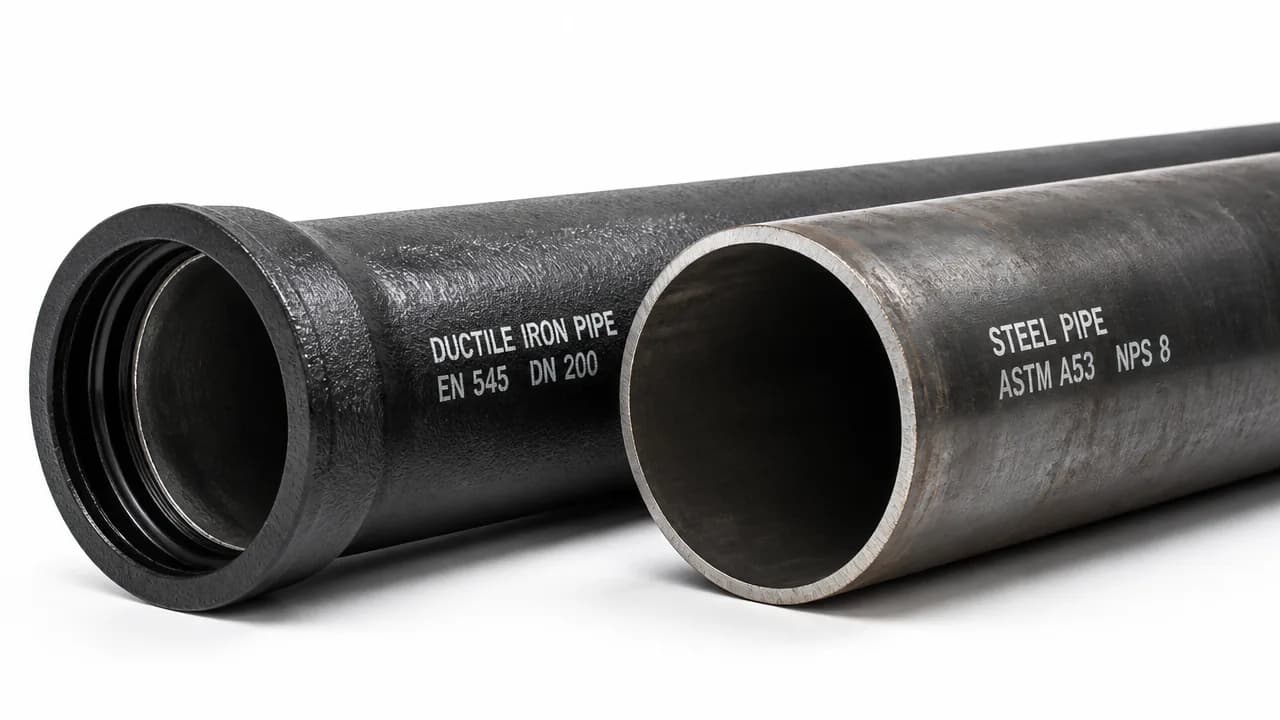
When it comes to choosing a pipe or structural component for building and industrial projects, the difference between ductile iron and steel pipe is not just a difference in name; this very choice can affect execution, durability, maintenance and even compatibility with site conditions. Ductile iron is an iron alloy that, because of its special structure, behaves mechanically differently from steel. Steel pipe, on the other hand, because of its composition and production method, offers other characteristics such as formability, weldability and a wide range of applications.
For contractors and engineers, comparing these two materials is not just a theoretical discussion; when choosing the right material for transmission networks, utilities and various parts of a structure, the right decision can prevent rework and extra costs. In this article, we examine the main differences between ductile iron and steel pipe in terms of nature, properties, applications, cost and durability so that you can make a more precise choice.
What Is Ductile Iron?
Properties of Ductile Iron
Ductile iron is an iron-based alloy in which the graphite appears in the metal structure in nodular or spheroidal form rather than as flakes. This change in internal structure sets its mechanical behavior apart from ordinary cast irons and allows the material to show greater tolerance to impact and sudden stresses. In practice, this property is very important for components that must be strong and also withstand a degree of deformation.
Ductile iron is produced by precisely controlling the chemical composition and adding special elements during the melting stage. In this process, the melt composition is adjusted so that the graphite forms in spheroidal shape as it cools. The result of this structure is a metal that is less brittle than gray cast iron and more reliable in mechanical performance. For this reason, ductile iron is mainly known as a material that strikes a balance between high compressive strength and relative flexibility.
In terms of physical properties, this alloy usually has a relatively hard surface, high density and good resistance to pressure. Chemically, iron and carbon form its main base, and control of the amount of alloying elements plays an important role in the final quality. The more precise the production, the more uniform the internal structure and the more stable the component's behavior under harsh operating conditions. For example, in urban water transmission networks, a pipe or component made of ductile iron can perform more reliably against internal pressure and impacts from handling or installation.
Advantages of Using Ductile Iron
The most important advantage of ductile iron is its combination of strength and the ability to tolerate deformation. This makes it a suitable choice for components subjected to continuous loading or intermittent impacts. In addition, its more uniform mechanical behavior compared with some types of cast iron reduces the risk of sudden failure, which is of practical importance in civil and industrial projects.
Ductile iron also performs acceptably under operating pressure and abrasion, especially in components in direct contact with fluids, soil or moving parts. This property has led to its use in making components such as fittings, the bodies of some valves, transmission pipes and infrastructure elements. In a project where a pipe must both withstand internal pressure and resist impacts from transport or minor soil settlement, using ductile iron can be the more reliable technical choice.
Another of its advantages is that it can be used in various industrial and building environments. Contractors and engineers usually look for a material that, in addition to durability, causes fewer problems in installation and operation. Thanks to its suitable structure and dependable mechanical strength, ductile iron has an important place in such conditions, and this has made it one of the main options in utilities and infrastructure.
Properties of Steel Pipe
Physical Characteristics of Steel Pipe
Steel pipe is made by rolling and forming steel and, depending on the production method, falls into several common groups, such as welded (seamed) pipe and seamless pipe. Welded pipe is usually used in projects where speed of supply and a variety of dimensions matter, whereas seamless pipe is more relevant where operating pressure, body uniformity and structural reliability have higher priority.
Physically, these pipes have a smooth, uniform surface and, by choosing the right wall thickness, they can be used for different conditions. Their weight varies with diameter and wall thickness, and this directly affects transport, installation and bracing. In industrial projects, this ability to choose wall thickness and dimensions allows the designer to match the pipe to the real needs of the line, not the other way round.
Mechanically, steel pipe usually has good tensile strength and resistance to internal pressure, and also behaves acceptably under impact. Of course, these properties depend on the steel grade, build quality and operating conditions. If a suitable protective coating or paint is not used, rust can gradually reduce its service life; therefore, in damp or corrosive environments, the choice of coating and maintenance is very important.
Advantages of Steel Pipe
The most important advantage of steel pipe is its flexibility in design and execution. Depending on pressure, temperature and type of fluid, the engineer can choose the appropriate type of pipe and consider a variety of fittings for long routes or process networks. This feature makes the work simpler in projects with complex piping routes.
Another advantage is its wide use in industry. Steel pipe is used to convey water, steam, oil, gas and in many process lines. In buildings, it is also a common choice for some risers, utility lines, fire protection and sections that need higher mechanical strength. For example, in an industrial workshop with steam and compressed air lines, steel pipe is usually a more practical option than many lighter materials because of its pressure tolerance and ease of connection.
In terms of execution, these pipes can also be cut, welded and connected to the existing network with various fittings. This makes rerouting or later expansion of the system easier. Although steel pipe needs surface protection for better durability, it is still considered one of engineers' main choices in projects where strength, availability of parts and ease of repair matter.
Comparison of Properties and Applications
Ductile Iron vs. Steel Pipe: Advantages and Disadvantages
Ductile iron and steel pipe are both used in utility and civil projects, but their behavior in real use is not the same. Because of its tougher structure, ductile iron performs more reliably against impact and sudden stresses and is considered the more established choice in networks where long-term stability is important. In contrast, steel pipe is usually better suited to conditions that call for lower weight, flexibility in execution or compatibility with certain industrial processes.
In terms of pressure tolerance and formability, the main difference comes down to the nature of the material. Ductile iron shows better resistance to brittle fracture, and if the project is exposed to ground settlement, vibration or construction impacts, this property becomes more valuable. Steel pipe, however, depending on the type of coating and operating conditions, can be more sensitive to corrosion and maintenance requirements and usually needs more care.
In terms of installation, each also has its own advantages. On some routes, steel pipe allows fast execution because of its lower weight and the possibility of welding. In contrast, ductile iron pipe is considered the more reliable choice in networks where durability, sealing and reduced risk of damage are priorities. For this reason, the project engineer should not look only at "strength"; operating conditions, type of fluid, quality of the bedding and the maintenance plan must also be assessed.
To give a practical summary, ductile iron has the edge mainly where line failure is costly and the project needs a long service life. Steel pipe becomes more sensible when execution constraints, structural weight or specific industrial process requirements are the priority. So neither is inherently better than the other; the right choice depends on the project's problem.
Analysis of Specific Applications
In water transmission, wastewater and urban infrastructure projects, ductile iron is usually the more suitable option, because these environments are often associated with variable pressures, backfill around the pipe and the possibility of localized settlement. In such conditions, a pipe that does not fail suddenly and maintains its seal better lowers the operational risk.
For industrial lines, steel pipe can be the better choice in some scenarios, especially when the system requires custom routes, special connections or tolerance of varying process conditions. However, if the operating environment is corrosive or access for repair is difficult, maintenance and coating costs must also be factored into the final decision.
A simple example: in an urban project where the pipe passes under a street, if traffic loads, vibration and limited access for repair are likely, ductile iron is usually the more logical choice. But in an industrial unit where the piping route must be coordinated with existing equipment and route changes are frequent, steel pipe can make project execution easier.
The key point in choosing is not to look only at the pipe material but to make the "operating conditions" the criterion. Operating pressure, type of fluid, the surrounding soil or air, the possibility of repair and the project's sensitivity to operational shutdowns all affect the final decision. If your project is exposed to environmental stresses and difficult repairs, ductile iron will usually be the lower-risk choice; but if speed of execution and route flexibility matter more, steel pipe can be the more suitable option.
Cost Comparison
Production and Supply Costs
The initial cost of ductile iron and steel pipe does not depend only on the price of the raw material. The production method, type of coating, manufacturing standard, dimensions and even the means of transport can create a price gap. For ductile iron, the casting and forming process for fittings or pipes usually requires equipment and precise quality control. Steel pipe, in turn, can have different costs depending on wall thickness, whether it is welded or seamless, and the anti-corrosion coating.
In terms of supply, the market and local availability also have a direct effect. If the project is carried out in an area where heavy transport or sourcing a specific product is difficult, the final cost rises, even if the factory price seems reasonable at first glance. Also, in some projects the need for fittings, flanges, internal or external coatings and surface preparation makes up a significant part of the budget, and the price of the pipe itself should not be the only criterion.
In a long-term comparison, a product that is slower to suffer damage, leakage or corrosion lowers repair and downtime costs. So an option with a higher initial price may be more economical overall than a cheaper one.
Cost Analysis in Different Projects
Whether ductile iron or steel pipe is more economical depends on the type of project. In water, wastewater or fluid transmission networks where operating pressure and durability are important, ductile iron is usually considered a defensible choice because of its good service life and lower need for repairs. In these projects, although the start-up cost may be higher, replacements and interventions become less frequent and the life-cycle cost falls.
In projects where lower weight, installation speed or route adaptability matter more, steel pipe can be more cost-effective in execution, provided that corrosion protection and its maintenance costs are also included in the calculation. For example, in an industrial project inside a compound where access for inspection and repair is easy, steel pipe may be the more economical choice. But in a buried network whose repair requires re-excavation, the cost of failure can far exceed the initial savings.
The important point is that an economical choice should not be based only on the purchase price. The contractor and engineer must put together the cost of installation, ancillary equipment, possible operational shutdowns, the need for coating or protection, and the cost of periodic maintenance. If the project is long-term, a product with greater durability that reduces the risk of failure is usually more financially sensible. So a correct comparison is not a comparison of "today's price" but an assessment of the "real cost over the life of the project".
Strength and Durability of the Materials
Comparison of Corrosion Resistance
Ductile iron and steel pipe both need care and the right choice in corrosive environments, but their behavior is not the same. Because of its graphitic structure and alloy nature, ductile iron performs acceptably in many soil and water conditions and, if it receives suitable coating and protection, can show good durability in buried networks and underground facilities. In contrast, steel pipe is more sensitive to moisture, oxygen and some corrosive compounds, and if the external coating, insulation and cathodic protection are not applied correctly, the likelihood of rust and deterioration is higher.
In projects with damp soil, localized leaks or constant contact with water, the type of surface protection becomes the main concern. If the coating on a steel pipe is applied incompletely, minor damage can lead to localized corrosion and then spreading damage. Environmental conditions also affect ductile iron, but this material usually behaves more stably under certain environmental stresses, especially in buried applications.
For example, on an urban transmission line where parts of the route pass through damp soil and parts through an area with possible chemical contact, the engineer should not rely only on the pipe material. Soil type, coating quality, installation conditions and even the likelihood of damage during construction all affect the final choice.
Durability in Different Environmental Conditions
Real durability does not depend only on the material; how it is used in the field is also decisive. In many underground applications, ductile iron, if properly coated and installed, is considered a reliable option for long-term operation. This material usually behaves more stably under normal network pressures and environmental changes, and in projects where access for repair is difficult, this stability becomes more important.
Steel pipe can perform well in drier environments or where coating control, periodic inspection and preventive maintenance are possible. But in harsher environments, such as corrosive soils, areas with high humidity or places where mechanical damage to the coating is likely, its durability depends more on the quality of protection than on the steel itself.
From a technical selection standpoint, if the project is carried out in an environment where later maintenance is difficult, ductile iron is usually the lower-risk choice. But when weight, installation method, welding or the need for special construction details are at issue, steel pipe can also be suitable, provided the execution team has a clear plan for corrosion control and periodic inspection.
In practice, the engineer must strike a balance between three factors: the severity of environmental corrosion, the possibility of surface protection, and access for future repairs. The harsher the environment and the more limited the access, the more sensible it will be to choose a material with higher inherent durability and less sensitivity to environmental damage.
Conclusion
The comparison shows that ductile iron and steel pipe both have applications in civil and utility projects, but the right choice depends on the real working conditions. If the project faces mechanical pressures, impacts during operation or a need for long-term stability, ductile iron usually appears to be the more reliable and less troublesome option. In contrast, steel pipe becomes more important where the type of design, execution method and specific structural or industrial requirements are the main priority.
The key point is not to base the final decision solely on the name of the material. You must consider the installation location, operating conditions, connection method, maintenance requirements and the sensitivity of the project together. In a work site or transmission network, sometimes the main difference lies not in the pipe itself but in the quality of supply, the suitability of the fittings and the coordination of the system's components. If this coordination is not chosen correctly from the outset, even a suitable material will cause problems in execution.
For this reason, access to a reputable source that provides pipe and fittings supply services with a precise approach is very important. At this stage, ghadirlouleonline.ir can act as a reputable source of quality pipes and fittings and meet the project's needs through a more reliable channel, especially when your goal is not just to buy goods but to choose materials compatible with the real conditions of the project.
If you are comparing options for purchase or supply, reviewing specialist sources and consulting a supplier that focuses on quality and technical compatibility reduces the risk of error. To source pipes and fittings suited to your project, you can visit ghadirlouleonline.ir and make a more precise choice.